
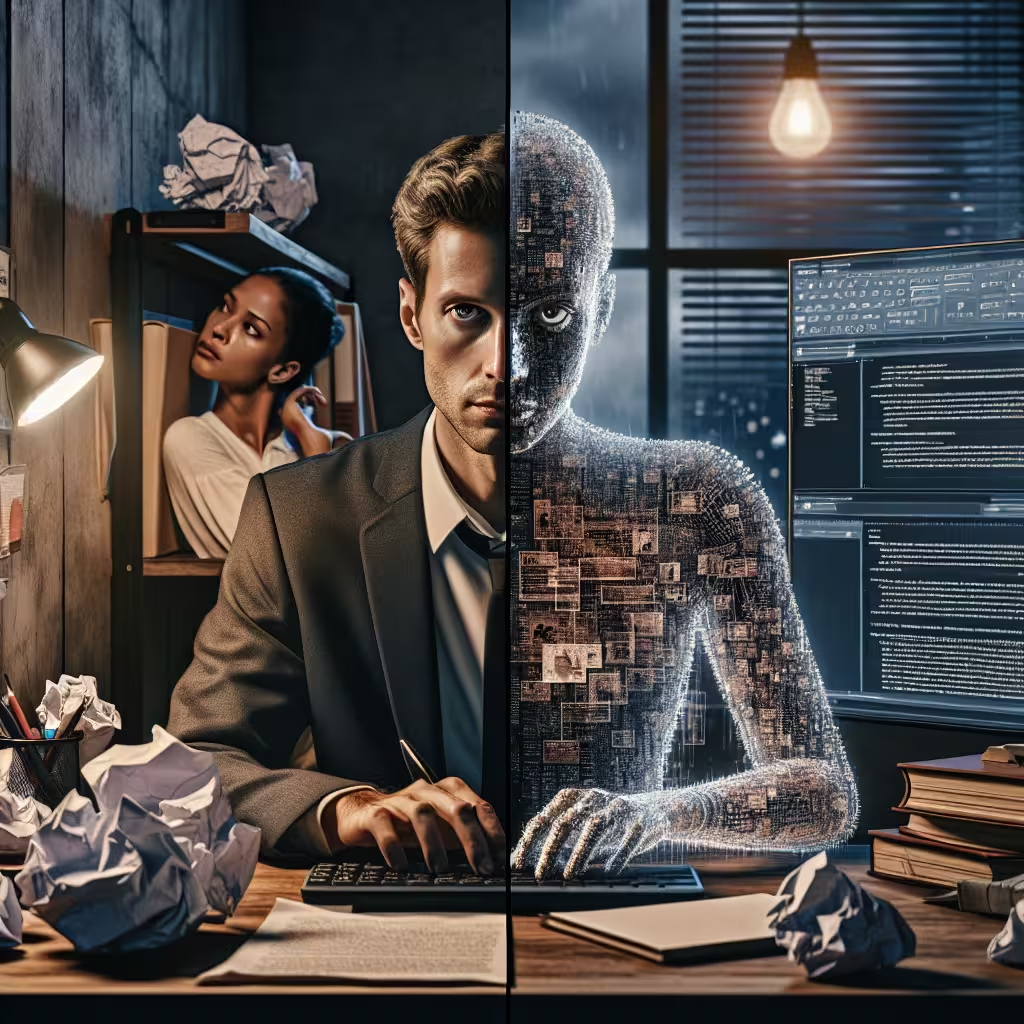
The Evolving Landscape of AI in Writing by 2026
Okay, so we're here, in early '26, and honestly, the whole AI writing landscape? It's truly nothing like what we might have pictured just a couple of years back. I remember the early days, where it felt a bit like a glorified autocomplete, but now these tools aren't just passively generating text; they're actually acting as agentic workflows, doing real grunt work for you. Think about it: they can autonomously cross-reference facts against live academic databases during the initial draft, which, let's be real, saves a ton of time and worry. And most of that heavy lifting, about 85% of enterprise writing, is now happening right on your device with those integrated Neural Processing Units, totally cutting out the latency and privacy headaches we used to get from cloud-based systems. But here's an interesting turn: we've essentially hit a "data wall" for human-generated training sets. So, now, a huge chunk—like 90%—of the really precise model refinement for specific technical writing niches is driven by high-fidelity synthetic data. It raises questions, doesn't it, about where the "human touch" goes? That's why professional platforms have integrated these cryptographic "proof-of-personhood" protocols, giving you an immutable audit trail of every single human tweak made to an AI-generated draft. It's a smart move for editorial integrity, I think. We've also seen a pretty dramatic 60% reduction in the energy cost per word generated, all thanks to the widespread adoption of Spiking Neural Networks, which are just way more efficient than those 2024-era transformer architectures. And, look, simultaneous multi-language co-authoring with perfect conceptual alignment? That's not just a dream anymore. This whole shift, especially with contextual hyper-personalization that adapts text to a reader's cognitive profile in real-time, really pushes us to consider how we connect with our audience on a much deeper, more personalized level, and honestly, that's exciting.
Boosting Efficiency: AI for Drafting, Editing, and Optimization
We're all trying to write something that truly connects, right? But it's tough, making sure every single word hits, that your message is clear, and that, crucially, it still sounds like *you*. I mean, think about the mental gymnastics involved in getting a solid draft out, then editing it, then optimizing it so it actually *works* for whoever's reading. Honestly, this is where the newest AI tools feel less like a novelty and more like a genuine co-pilot, seriously boosting our capabilities. I’ve seen these drafting interfaces, and they're pretty wild; they can actually micro-A/B test different phrasing *as you type*, predicting which words will land best with your audience before you even think about hitting send. And for the editing phase, you know that moment when you’ve read a long document a hundred times and still miss a subtle logical inconsistency? Well, advanced AI editing suites are now like super-powered semantic detectives, sniffing out those nuanced contradictions that even the sharpest human eye might gloss over, ensuring a truly unified narrative. What I really appreciate, though, is how some of these systems adapt to *your* unique linguistic fingerprint, learning your voice so their suggestions enhance clarity and conciseness while keeping *your* distinct style intact. Plus, imagine never having to worry if your emotional tone suddenly shifts; AI can map that trajectory, recommending tweaks to maintain a consistent impact on the reader. And for folks in highly regulated fields, like pharma or finance, AI systems are now doing initial compliance reviews on complex documentation, achieving accuracy rates around 97.2% and seriously cutting down human legal review time. They can also provide granular readability scores tailored for specific groups, like non-native English speakers, helping you fine-tune text for maximum accessibility across diverse audiences. So, it's not just about speed anymore; it’s about a deeper, more thoughtful kind of efficiency, letting us focus on the big ideas and human connection while the AI handles so much of the detailed optimization.
Upholding Integrity: Advanced Plagiarism Detection and Originality Checks
Look, we can't just trust that a slick block of text is purely ours anymore, not when the tools generating content are getting so stealthy; it's like the digital dust motes left behind are the only evidence. I mean, the tech has moved way past just checking for copy-paste jobs; we’re talking advanced detection now, using things like adversarial machine learning to spot those tiny stylistic wobbles that scream "LLM derivation." Think about it this way: if the writing is too smooth, too perfectly predictable in its flow, that’s actually a red flag now, which is a weird thing to say about writing quality. These modern originality checkers calculate something they call the Perplexity-Burstiness Divergence score, and that number is what really separates a human's natural rhythm from a machine's steady cadence. And to combat people trying to sneak past detection, about 40% of the serious software out there is embedding these almost invisible cryptographic watermarks right into the text, which survive even heavy rewriting attempts. But here’s the kicker: sometimes the plagiarism isn't even from a human source; these systems are flagging content that was just poorly trained on existing synthetic data, meaning the AI is accidentally plagiarizing *itself*. We’re seeing false positives drop, which is good—down to about 3.5% on the best platforms—but we still need forensic analysis to map out exactly how much of the core idea came from the machine versus our own keyboard strokes. It forces us to be meticulous, ensuring that the final version is demonstrably *our* concept, even if the first draft got a massive AI assist.
Beyond Automation: AI as a Creative Partner and Strategic Assistant
You know, for a while, we’ve probably thought of AI as that super-efficient intern, just churning out words, right? But honestly, it’s evolving into something much deeper, almost like a genuine creative partner, and that's incredibly exciting to watch. I’ve actually seen systems that can map out entire narrative arcs for longer pieces, figuring out the perfect story pacing to keep readers absolutely glued. Think of it: it's not just generating text; it’s shaping the whole emotional and structural flow, which is wild. And for those moments when you’re just staring at a blank page with a really complex idea, these tools can act like a fantastic sounding board, giving you different conceptual angles, analogous structures, or even structured counterarguments, really speeding up that initial ide